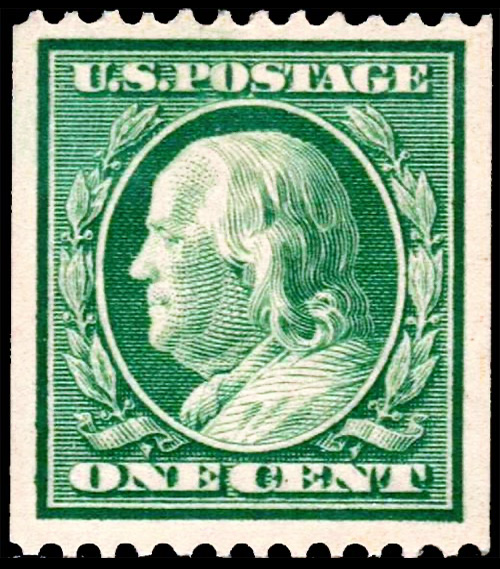
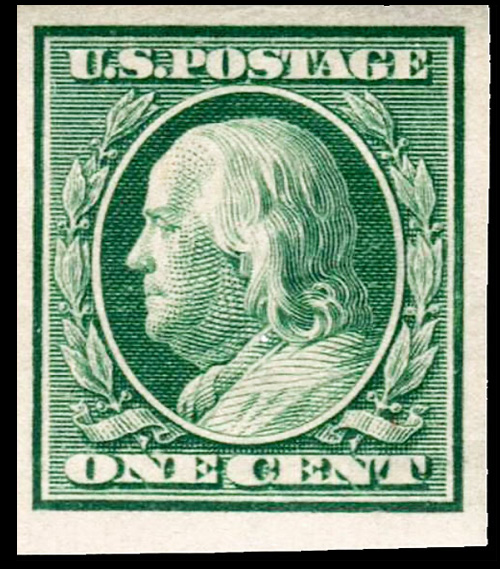
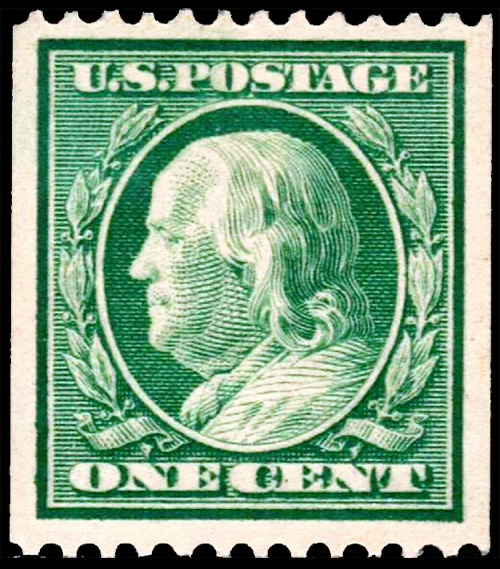
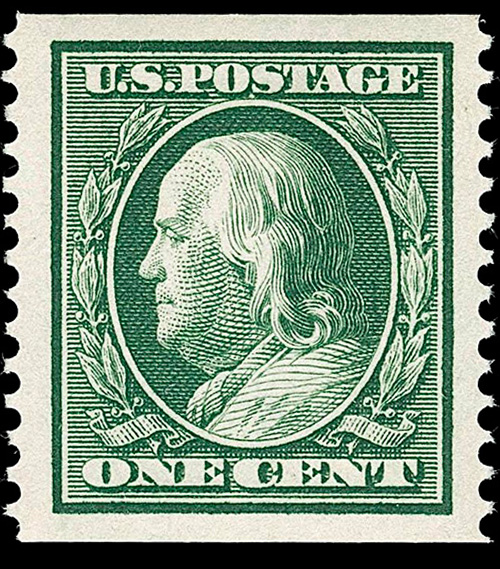
#348 1908 1¢ Coil

Basic Information

Color: Green
Subject: Benjamin Franklin
Watermark: Watermarked double-lined USPS
Printing method: Flat plate
Perforations: perf 12 Horizontally
Scott #: 348
Quantity issued: 12,449,300 (all 1908/09 1¢)
Issued: December 29th, 1908

Value for pairs

An unused pair with perfect gum: $110-$120
An unused pair with gum and a hinge mark: $40-$50
A used pair: $300-$325
Values are for stamps with two margins

Value for singles

An unused stamp with perfect gum: $10-$20
An unused stamp with gum and a hinge mark: $6-$10
A used stamp: $4-$7
Values are for stamps with two margins

About #348

A rare used pair of #348

It was not until early in 1908 that the Post Office Department issued some coil stamps of the 1902 series for use in vending and stamp affixing machines, but purely as an experiment. They were found to be satisfactory and as the Department realized that a demand existed for this type of stamp it was less than three weeks after the new design had been issued in the ordinary form that it was also available in coil form.

As in the previous issue they were made from the regular 400 subject sheets which were perforated twelve in the horizontal spaces between the stamps and then cut into strips of twenty. The horizontal guide line appeared in the middle of each of these strips, which were pasted together by hand and rolled into coils of 500 and 1,000. These were coiled on one half inch diameter pasteboard cores. A "paste up" or line pair, therefore, occurred every twentieth stamp and are about eight times scarcer than the ordinary pairs.

This type of coil was never as popular among users as the endwise coil.

Guide Lines

A guide line pair

Stamps with a guide line between two stamps command a 25% premium. The line can be seen along the perforating in the middle of the pair.

Usage

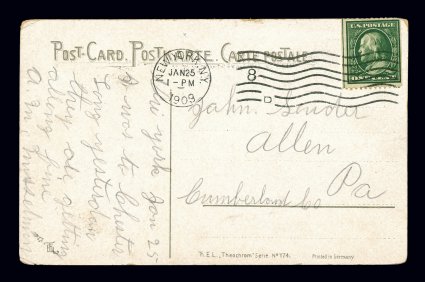
#348 - Earliest documented date of use, January 25th, 1909

The 1¢ Benjamin Franklin stamp was used specifically for:
Postcards: The standard rate for sending a postcard anywhere in the United States. It was the primary use for this stamp.
Third-Class Mail & Printed Matter: Bulk circulars, newspapers, and printed items (priced at 1¢ for every 2 ounces).
Make-up Rate: Combined with other denominations to meet higher or odd postage rates.

The Plates

The plate numbers on the sides having been cut off and those on the top and bottom being covered by the paste up. As a consequence no plate numbers can be found on the vertical coils perforated horizontally.

Identifying the Watermark on #348

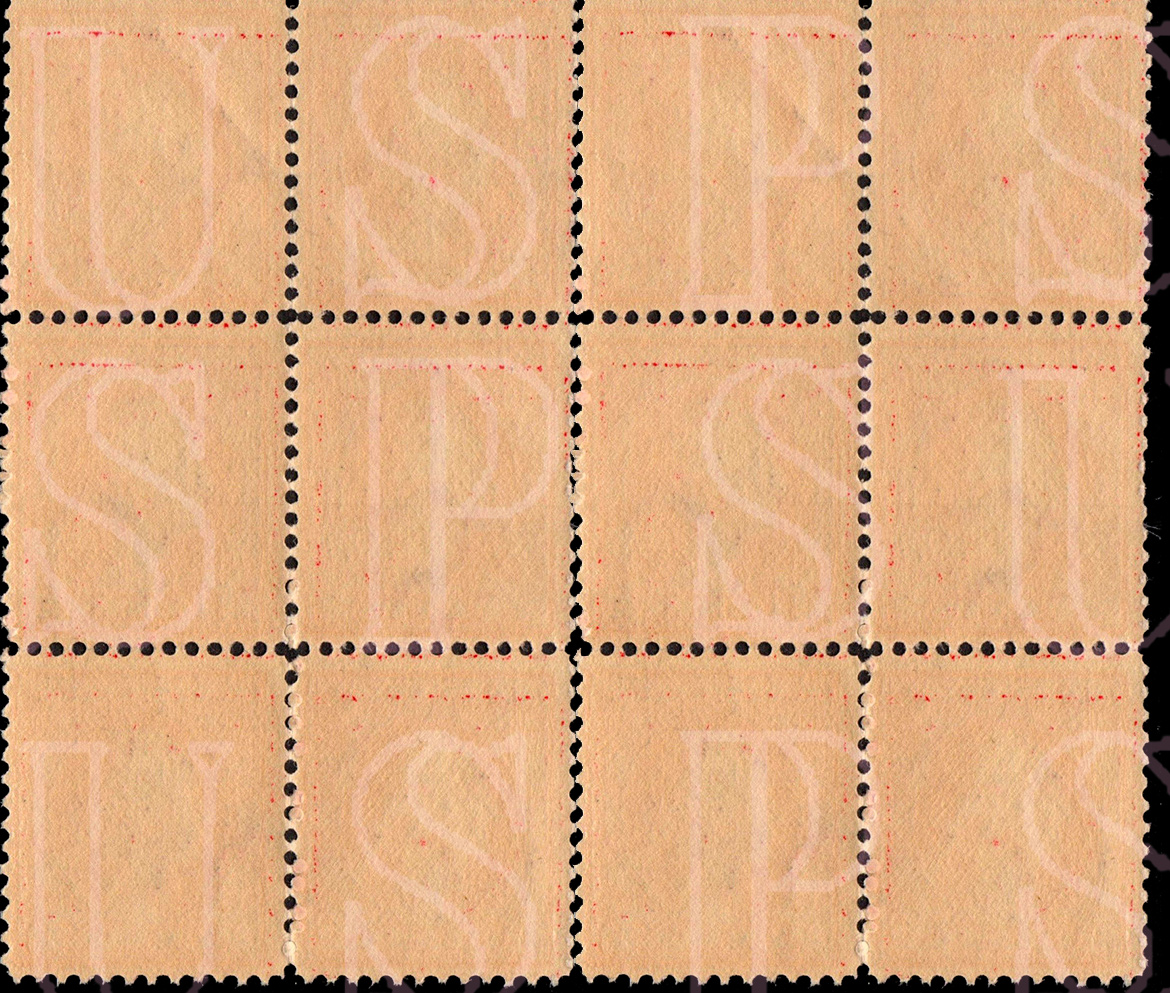
The DOUBLE lined USPS watermark

The SINGLE lined USPS watermark

Between 1895 and 1916 the U.S. government used two different watermarks, double line and single line with the letters "USPS".

By placing the watermark face down on a dark surface or holding it up to bright light you might be able to see the watermark. If you cannot see the watermark it might be a good idea to invest in watermark fluid and a watermark tray. Ronsons lighter fluid works just as well as watermark fluid. Both fluids evaporate quickly.

Pour a little fluid in the tray, lay the stamp face down. In a few seconds the stamp will absorb the fluid and reveal the watermark to you.

As you will see from the illustrations the letters can span several stamps, so on the watermark, for instance, you can see only part of the letter S in one corner and only part the letter P in the other corner.

The Inspiration for the Design

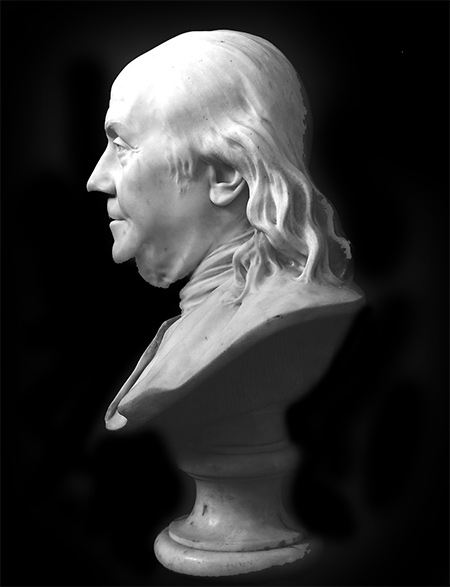
Benjamin Franklin bust by Jean-Antoine Houdon

The design of the orginal 1869 1¢ stamp with this vignette (#112) was inspired by a sculpture of Benjamin Franklin by Jean-Antoine Houdon, which is currently located in the Pennsylvania Academy of Fine Arts in Philadelphia.

It has been much debated whether Franklin actually sat for Houdon or if the sculptor captured his vividly accurate image from mere passing acquaintance. He would have had ample opportunity to observe the American minister at the Masonic lodge of the Nine Sisters to which they, as well as many other artists and patrons in the expatriate community (e.g., Count Stroganov; see Voltaire and Diderot), belonged. This cleanly truncated version, in modern dress, was clearly preferred by contemporary American statesmen and anticipates George Washington's insistence that Houdon's statue of him.