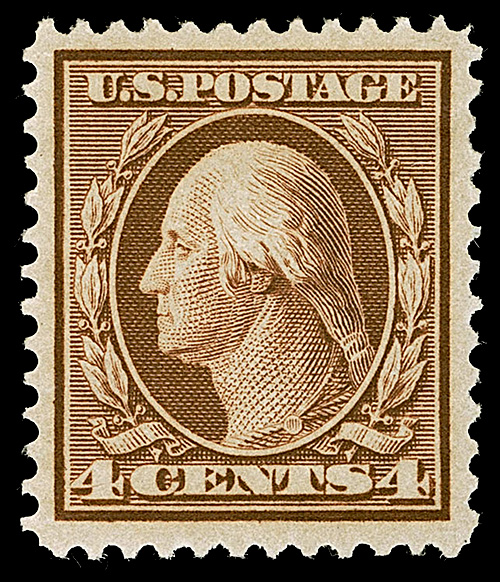
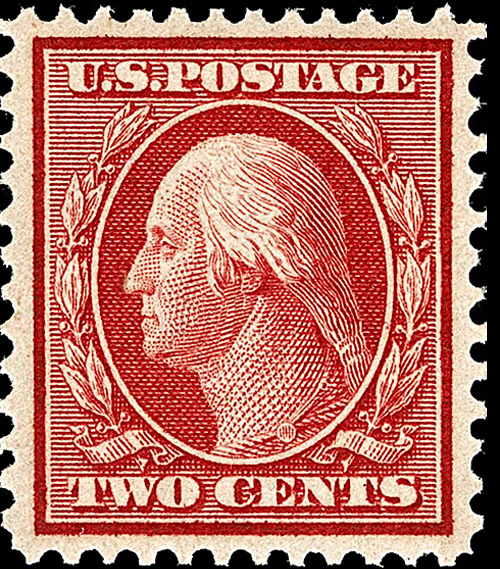
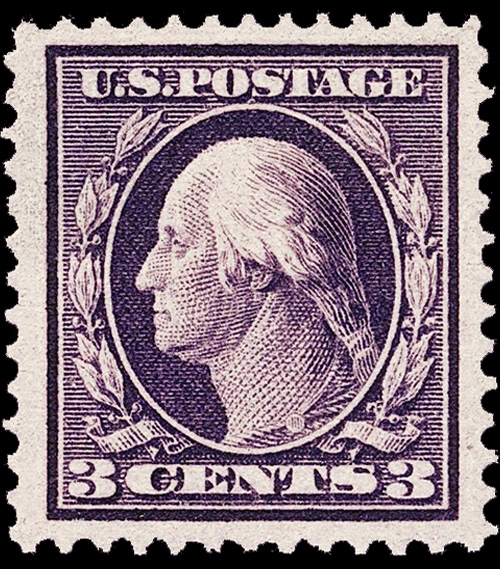
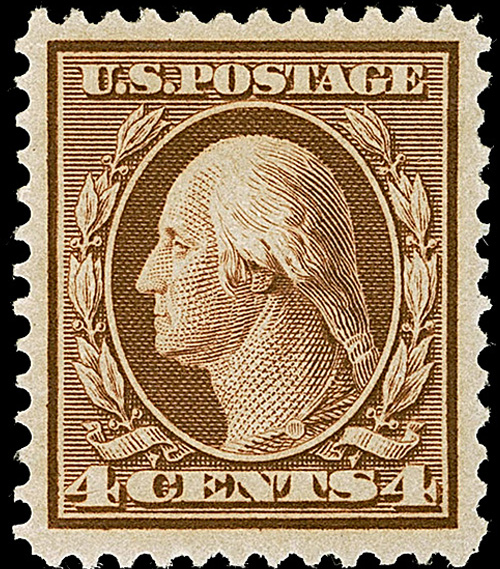
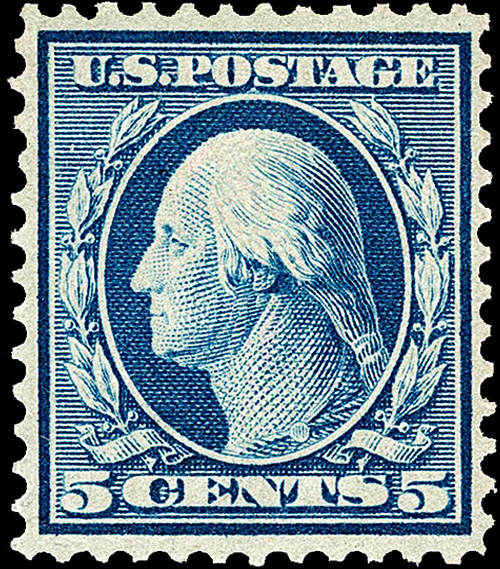
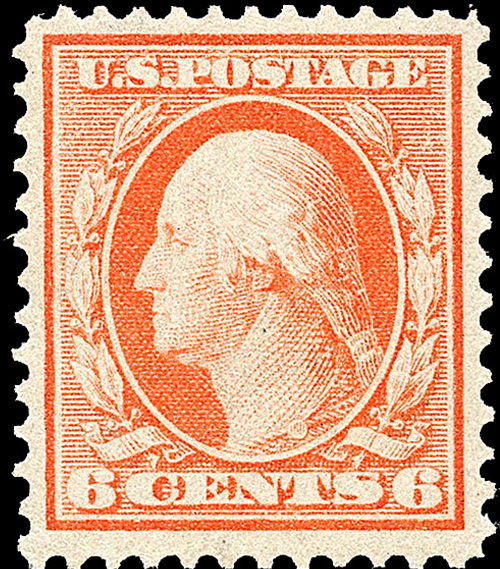
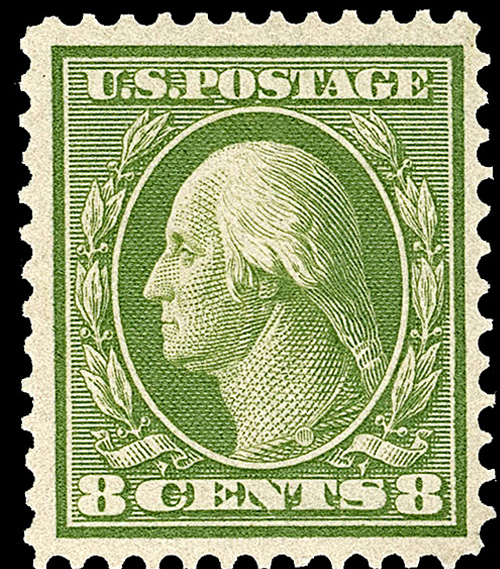
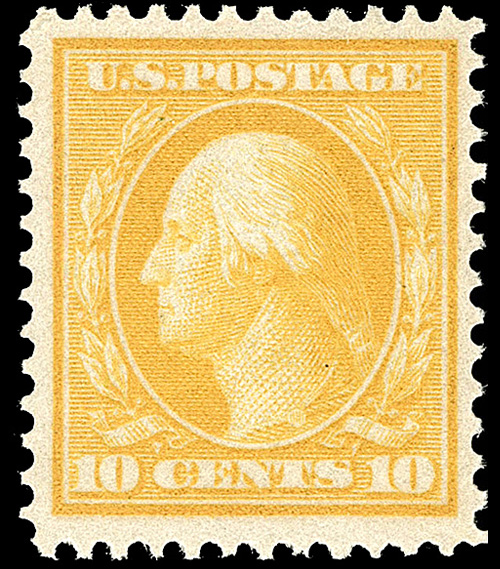
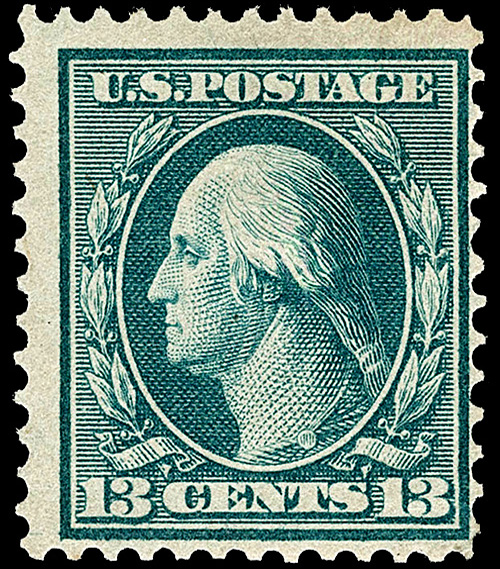
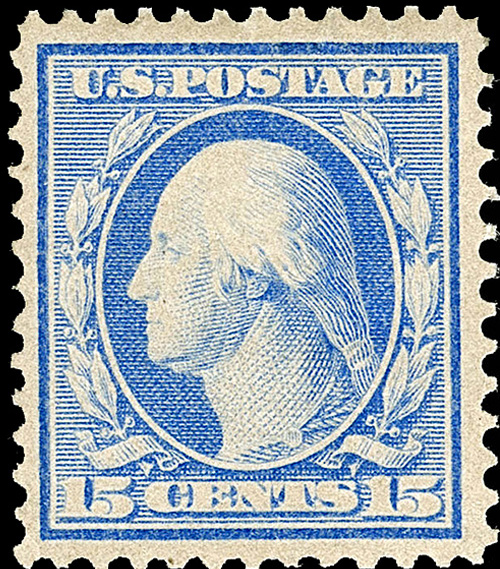
Color: Orange Brown on Bluish Paper Subject: George Washington Watermark: Watermarked double-lined USPS Printing method: Flat plate Perforations: 12 Scott #: 360 Quantity issued: Approx. 200 Issued: June, 1909
Value
An unused stamp with perfect gum:$19,500-$20,000 An unused stamp with gum and a hinge mark: $4,750-$8,000 A used stamp: No sales recorded
About Bluish Paper
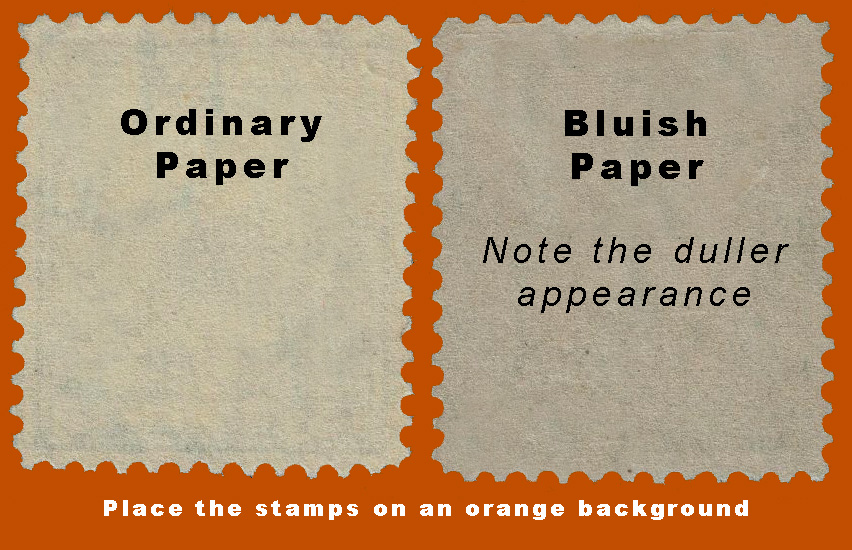
This was a printing on special paper containing about one third rag stock. It was hoped that this grade would materially reduce the great waste due to irregular or "off center" perforating, caused by the unequal shrinkage of the ordinary paper used. This "rag" paper did not help the question of shrinkage to any extent and was soon abandoned.
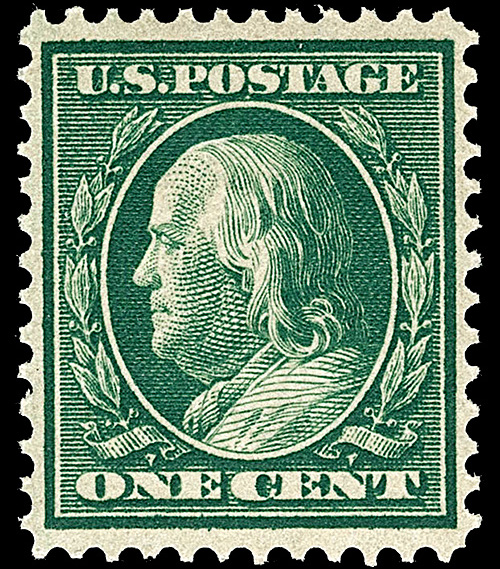
According to the official report of the Post Office Department 1,480,000 copies of the one cent were issued on this bluish paper. They were sent to the Washington Post Office for sale as ordinary stamps, the Bureau not considering them as anything special. Most of them were printed from the standard spaced plates and blocks of four with the 3mm spacings are almost impossible to obtain, while the others are far from common.
Although this group of stamps have always been noted as having been printed on bluish paper, the safest check as to their proper identification is by noting the greyish, color of the paper through the gum on the back, when compared to the ordinary stamps.
Usage
There are no known covers of #360
In 1909, standard domestic first-class letters cost 2¢ per ounce. Therefore, the 4¢ stamp was primarily used to pay double-weight first-class postage for letters weighing up to 2 ounces.
Because 4¢ did not align with a single standalone rate, the stamp also had several other practical uses:
Registry Fees:Two 4¢ stamps were used to pay the 8¢ domestic registry fee. Special Delivery:Three 4¢ stamps could cover a 10¢ special delivery fee plus a standard 2¢ domestic letter. Mixed Usage: Patrons frequently combined 4¢ stamps with other denominations to fulfill larger package weights or complex international mail rates.
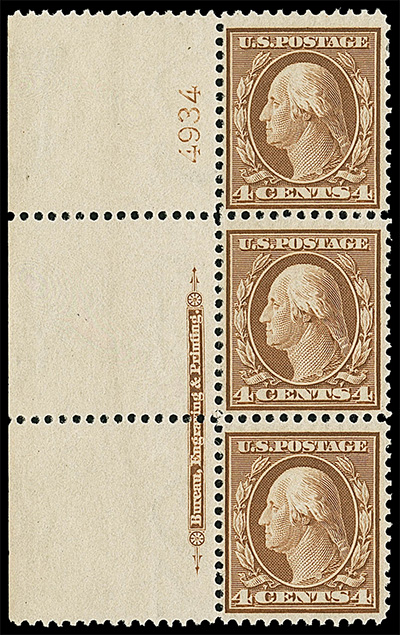
The Plates
#360 was issued with the following plate #'s
Imprint and number 4934
Identifying the Watermark on #360
The DOUBLE lined USPS watermark found on #331
The SINGLE lined USPS watermark
Between 1895 and 1916 the U.S. government used two different watermarks, double line and single line with the letters "USPS".
By placing the watermark face down on a dark surface or holding it up to bright light you might be able to see the watermark. If you cannot see the watermark it might be a good idea to invest in watermark fluid and a watermark tray. Ronsons lighter fluid works just as well as watermark fluid. Both fluids evaporate quickly.
Pour a little fluid in the tray, lay the stamp face down. In a few seconds the stamp will absorb the fluid and reveal the watermark to you.
As you will see from the illustrations the letters can span several stamps, so on the watermark, for instance, you can see only part of the letter S in one corner and only part the letter P in the other corner.
The Inspiration for the Design
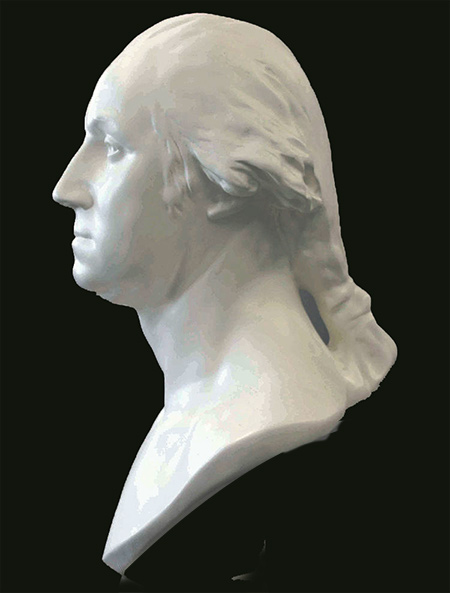
George Washington bust by Jean-Antoine Houdon
The vignette was based on a bust of George Washington by french sculptor Jean-Antoine Houdon.
Created in 1785 the bust is considered the most accurate likeness of the first U.S. president. Based on a life mask and clay model made at Mount Vernon, it captures Washington at age 53 with precise facial details, blending a Roman, toga-style aesthetic with realistic aging. It is considered one of the most accurate representations of Washington.