#441 - 1914 - Perf. 10 Horiz. - Flat Plate - Single line USPS wmk

See below for details
Basic Info
1¢ Green or deep green
Printing Method: FLAT PLATE
Subject: George Washington
Number issued: 85,730,000
Perforations: 10 horizontally
Watermark: Single Line USPS wmk
Scott #: 441
Issued: November 14, 1914
Value
As Pairs
Used
$15 - $30
No postmark with gum (MH)
$10 - $50
Full perfect gum, no postmark
no trace of stamp hinge mark (MNH)
$35 - $75
Add 50% if the pair has a line between the stamps (Line Pair)
As Singles
Used
$1 - $5
No postmark with gum (MH)
$16 - $13
Full perfect gum, no postmark
no trace of stamp hinge mark (MNH)
$12 - $21
Earliest Known Use
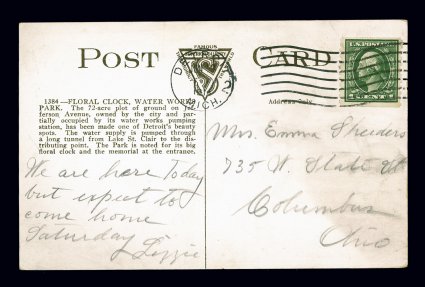
The earliest known use of #441, June 19th 1914
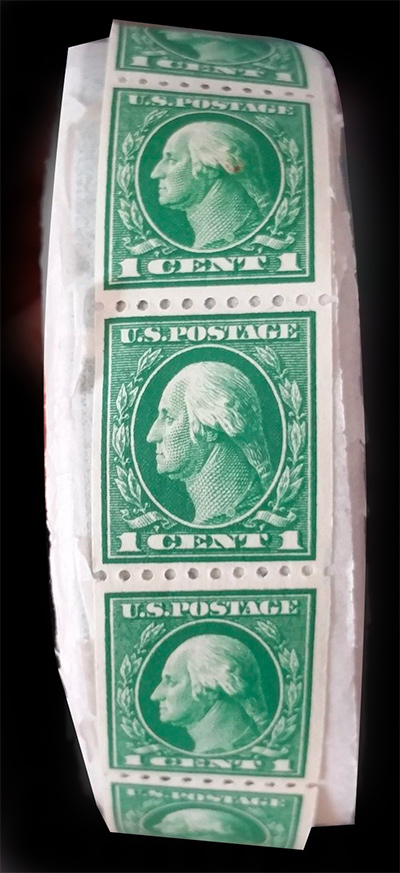
A Full Coil
The Design Inspiration
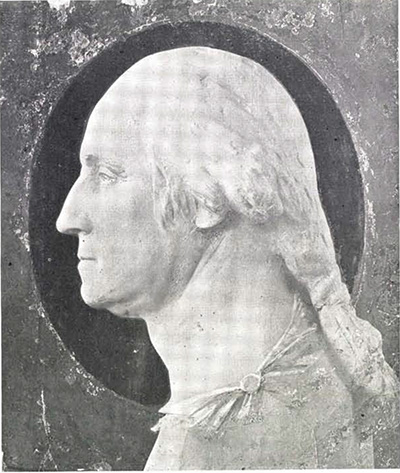
Using this photograph, the stamp designer Clair Aubrey Huston added the toga cord and button. The engravers of the stamp were M.W. Baldwin (who engaged almost all US stamps of this era. The lettering was engraved by Robert F. Ponicka and Edward M. Hall.
Flat Plate?
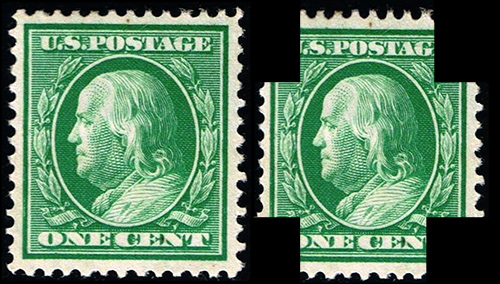
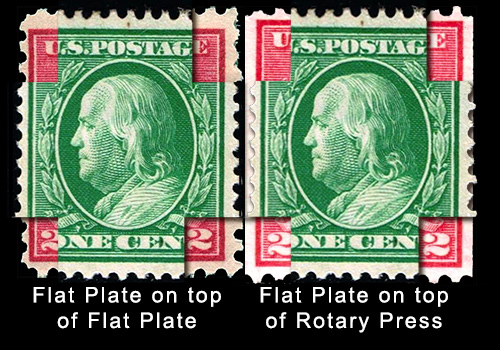
As the curved plates of the Rotary press made the stamps slightly larger, it is relatively easy to discern which stamp is flat plate and which is a rotary press stamp. First, select any perf Washington Franklin stamp or the first issue Washington Franklin 1 cent or 2 cents. These are the stamps with the numbers one and two spelled out instead of numbers displayed. I chose the latter alternative, as shown in the first image above.
Then cut out squares at each corner, as shown in the second image above. Placing the stamp, you wish to test under your cut-out stamp to test if the frame lines match. If, as in the last image shown above, the frame lines are outside the top stamp in either the top, bottom, or sides then you have a rotary stamp. If the lines are in the same place, you have a flat plate stamp, as shown in the third image.
This test works with any value stamp.
The Watermark

The watermark consists of single lined USPS letters. A stamp may show only part of a letter or letters
The 1913-15 Perf 10 Coils
Click your selected stamp


