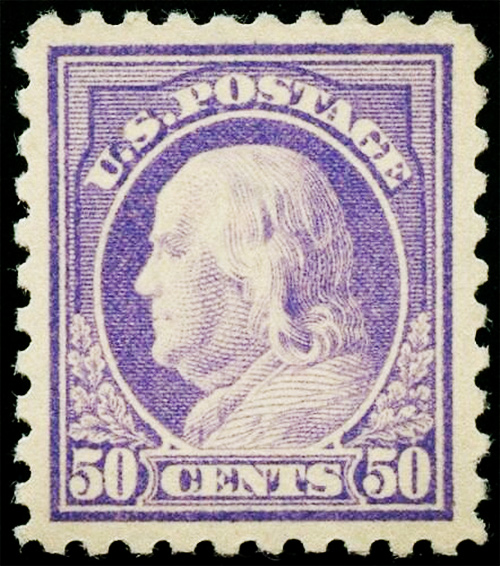
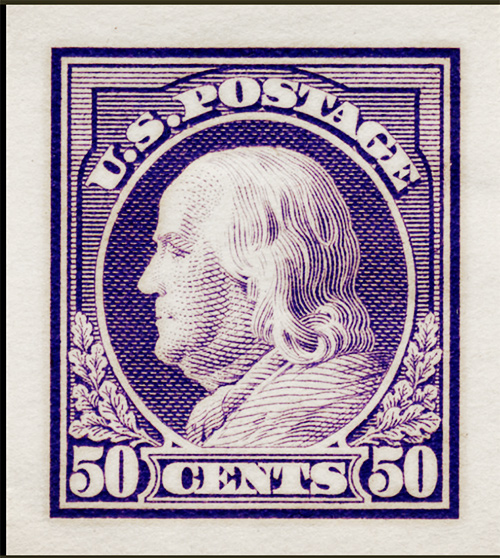
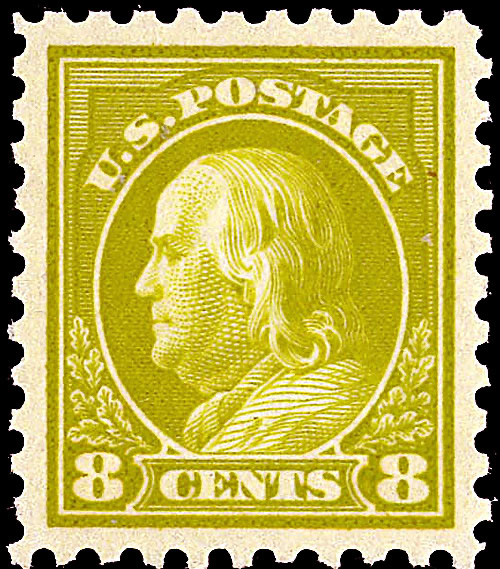
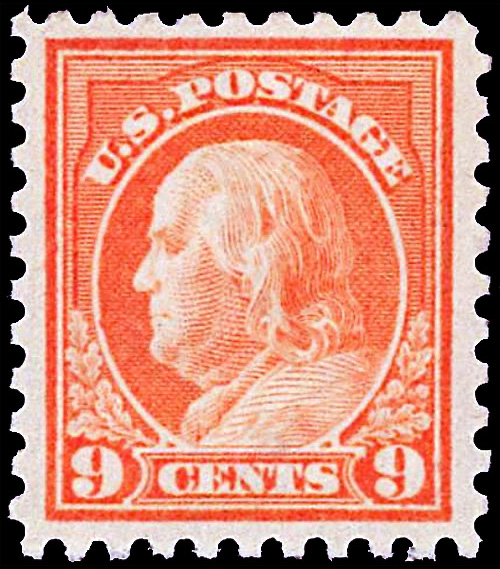
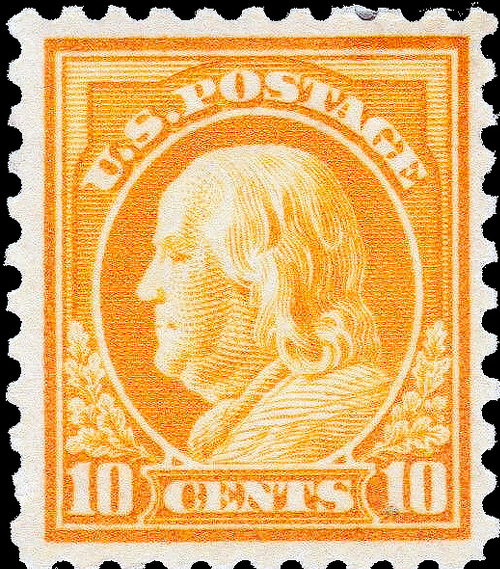
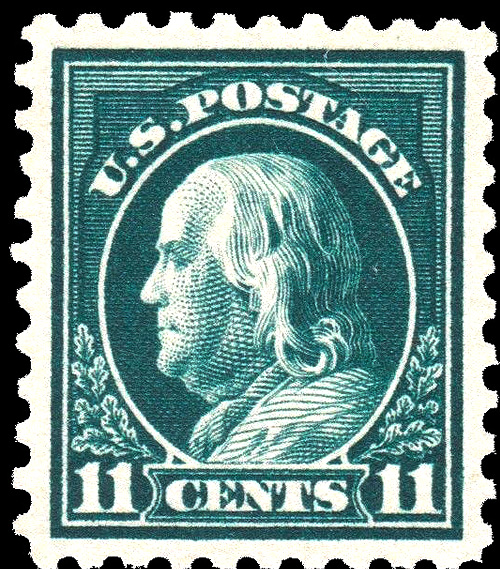
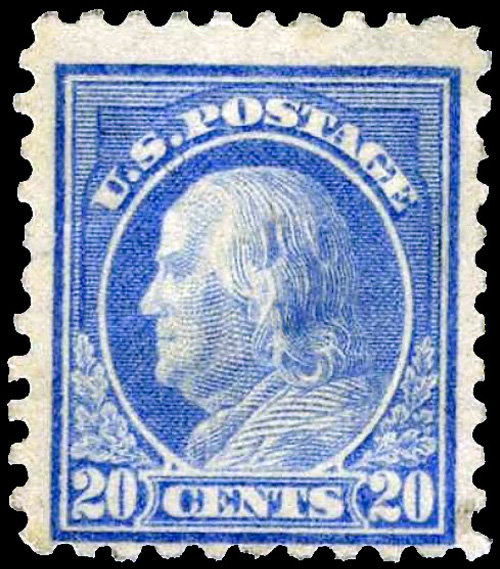
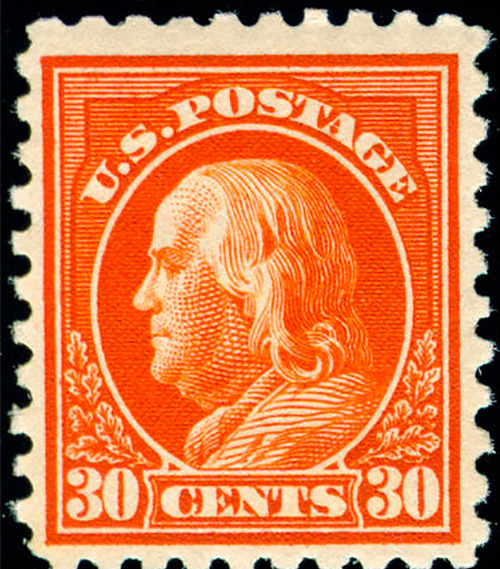
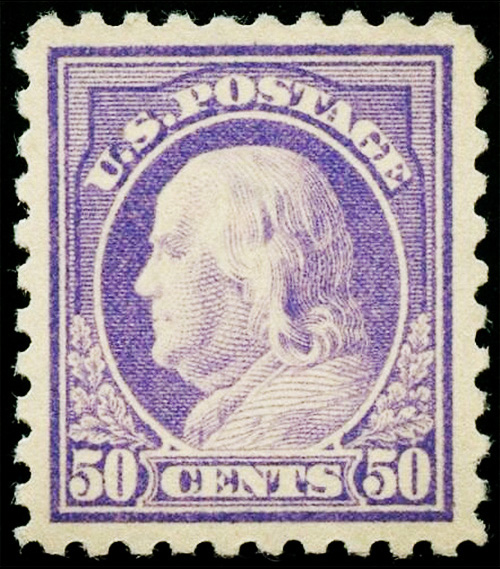
Color: Violet Subject: Benjamin Franklin Watermark:SINGLE-lined USPS Printing method: Flat plate Perforations: 10 Scott #: 440 Quantity issued: 3,350,000 Issued: March 10th, 1915
Value
An unused stamp with perfect gum:$400-$800 An unused stamp with gum and a hinge mark: $100-$250 A used stamp: $4-$8
Changing from 12 to 10 perforations
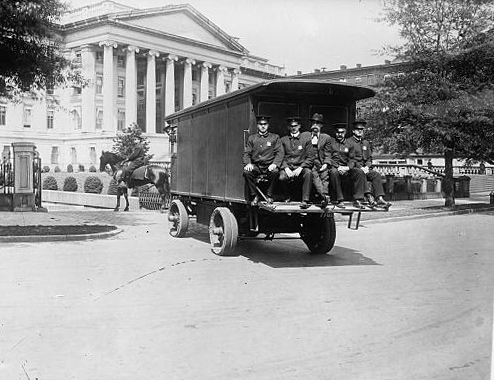
The flat plate press
The change from perforation 12 to perforation 10 during 1914 was driven by widespread public and postal worker complaints that the old gauge 12 perforations were too close together and brittle, causing stamp sheets to tear and fall apart too easily during routine handling.
Background and Evolution Perforation 12 Issues: Introduced around 1908, the 12-gauge holes weakened the paper (especially where watermarks intersected), leading to premature separation. Coil and Machine Experiments: Earlier adjustments to an 8½ gauge for mechanized coil dispensers proved too tough to tear, forcing a compromise. The Shift to Gauge 10: The Bureau of Engraving and Printing transitioned sheet and coil formats to a coarser 10-gauge perforation in 1914 to create a sturdier separation standard. Public Reaction: The new gauge 10 sheet stamps proved too coarse for many users, resulting in tearing rather than clean separation, which soon prompted a further adjustment to gauge 11 for sheets.
In 1914, used individually, the primary purpose of this high-denomination stamp was to provide a convenient, single-stamp option for large-weight mailings and international shipping, saving postal clerks from having to paste multiple smaller-value stamps onto bulky packages.
This stamp was only current for a little over a year, and dealers who had loaded to financial capacity with former issues did little to help collectors obtain copies for their collections by stocking up on this stamp while it was current. As a result, this stamp is less common and of higher value. Unlike the rest of this series, they were issued in sheets of 200.
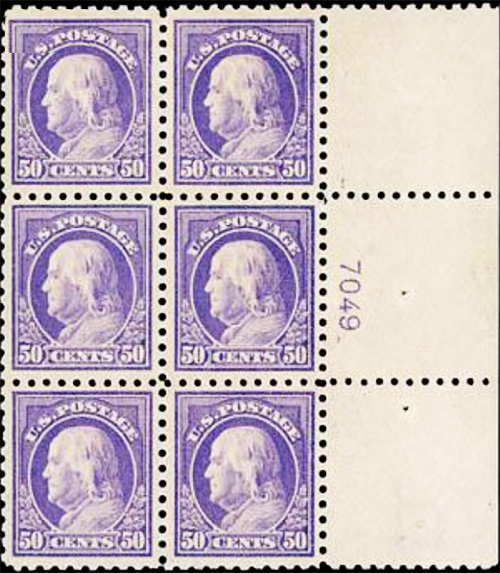
The Plates
#440 was issued with the following plate #'s Number only 7040-42, 49, 57

Identifying the Watermark on #440
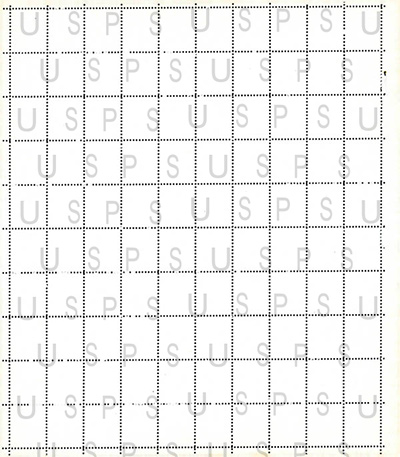
The SINGLE lined USPS watermark of #440
The watermark on the stamp is very faint.
Between 1895 and 1916, the U.S. government used two different watermarks: double-line and single-line, with the letters "USPS".
By placing the watermark face down on a dark surface or holding it up to bright light, you might be able to see the watermark. If you cannot see the watermark, consider investing in watermark fluid and a watermark tray. Ronsons lighter fluid works just as well as watermark fluid. Both fluids evaporate quickly.
Pour a little fluid in the tray, lay the stamp face down. In a few seconds, the stamp will absorb the fluid and reveal the watermark to you.
As you will see from the illustrations, the letters can span several stamps, so on the watermark, for instance, you can see only part of the letter S in one corner and only part of the letter P in the other corner.
The portrait of Benjamin Franklin used for the vignette was adapted from a sculpted bust created by the renowned French artist Jean-Antoine Houdon in 1778. The Bureau of Engraving and Printing's primary designer, C. Aubrey Huston, utilized the profile from this famous sculpture for the Franklin profile, which was then engraved by artists Marcus W. Baldwin, Edward M. Hall, and Robert Ponickau.